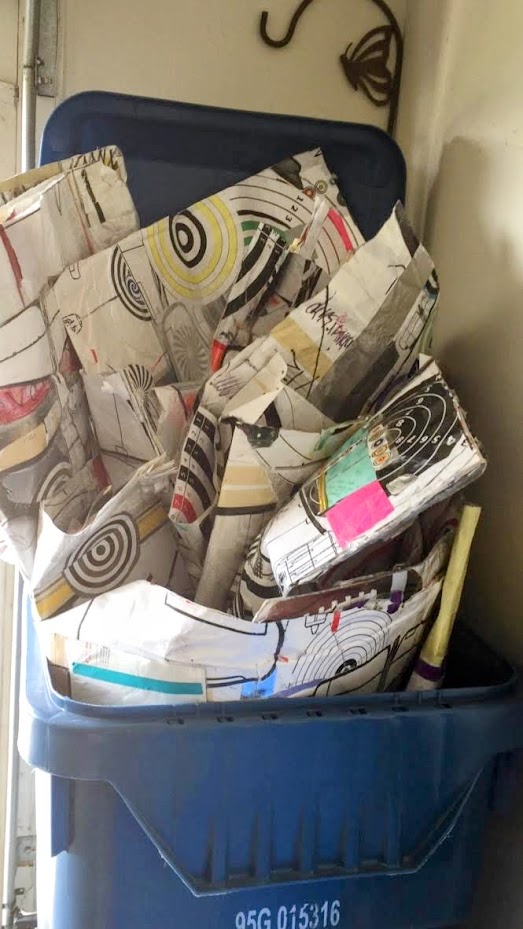
The 2000s. Rented space, broken water pipes. Cardboard, paper, canvas — the works that depended on dry storage soaked through. What could be salvaged was salvaged. Then, months later, bed bugs. What had survived the water didn’t survive the second event. Everything stored in that space had to be discarded — preventatively, completely.
No titles, no sizes, no images survive. The number isn’t precise because the number never existed — there was no inventory, no scan, no list. The frames below depict nothing. They stand for what is missing, one for one, as far as the estimate reaches.
Every frame above is empty because the record is empty.
A few works survive only incidentally, in the background of other
photographs. What remains is memory.
A full-scale interpretation of Picasso’s Guernica — approximately 11 × 25 feet, made in the basement studio on flexible material so it could be rolled and stored. It lived there for years. No one else ever saw it. Later moved to storage. Gone with everything else. Never photographed.
Asked, after more than thirty years of working with Guernica as a reference and structure, why he made something at that scale:
“It was about time.”
The archive on this site exists in part because of that loss. Every surviving piece is photographed, described, and backed up — so the work doesn’t disappear twice.